
Intro: what is a “good” ROAS by industry in 2026?
The real question behind “ROAS benchmarks” is usually: “Is our ROAS actually good?”
And the frustrating answer is: it depends, because ROAS swings wildly based on:
Industry economics (margins, returns, repeat rate)
Platform mix (Meta vs Google vs TikTok)
Attribution model and window (platform-reported vs GA4 vs Shopify)
Discounting and promo strategy
Whether you’re measuring first purchase or longer-term value
Still, benchmarks are useful. Not as a scorecard, but as a starting point for diagnosis.
In this guide, you’ll walk away with:
2026 ROAS benchmarks by industry (ranges, not made-up single numbers)
ROAS benchmarks by platform (Meta vs Google vs TikTok, and why they differ)
How to use ROAS benchmarks without fooling yourself
What to do if you’re below (or above) the benchmarks
A quick honesty note: these ranges are compiled from public reports, agency summaries, and common market observations across DTC, SaaS, and lead gen. Treat them as directional, not guarantees.

AI Agent for Paid Teams
Ask question in plain english Get insights across all platforms
Trusted by 1000+ marketing teams across 80+countries






What is ROAS?
ROAS (Return on Ad Spend) = revenue attributed to ads ÷ ad spend.
What ROAS is good for:
Comparing efficiency across campaigns and channels
Tracking performance over time (when measurement rules stay consistent)
Diagnosing where performance is improving or slipping
When ROAS can mislead:
Subscription businesses where revenue arrives over months
High-return-rate categories (fashion is the classic)
Heavy discounting (revenue looks good, margin disappears)
Weak attribution (platforms over-credit themselves, GA4 under-credits paid social)
One reminder (and I’ll only say it once): ROAS ≠ profitability. COGS, shipping, returns, payment fees, and overhead still exist.
AI Agent for Paid Teams
Ask question in plain english Get insights across all platforms
Trusted by 1000+ marketing teams across 80+countries
How ROAS is calculated
Formula:
ROAS = Attributed revenue / Ad spend
Simple example:
You spend $1,000
The platform reports $3,000 in purchase revenue
ROAS = 3,000 / 1,000 = 3.0x
The time window matters more than people admit
A “3.0x ROAS” can mean very different things depending on attribution settings:
1-day click: tight, tends to look lower
7-day click: common default for many teams
28-day click: often looks higher, especially for consideration-heavy products
You can only compare ROAS apples-to-apples when the time window matches.
View-through attribution can inflate Meta and TikTok vs GA4
Meta and TikTok can count conversions influenced by ad views (not clicks), depending on settings and modeling. GA4 often won’t match that, especially with consent limitations and cross-device behavior.
Quick takeaway: ROAS numbers only mean something when the calculation rules stay consistent (window, attribution, revenue definition, and deduping).
AI Agent for Paid Teams
Ask question in plain english Get insights across all platforms
Trusted by 1000+ marketing teams across 80+countries
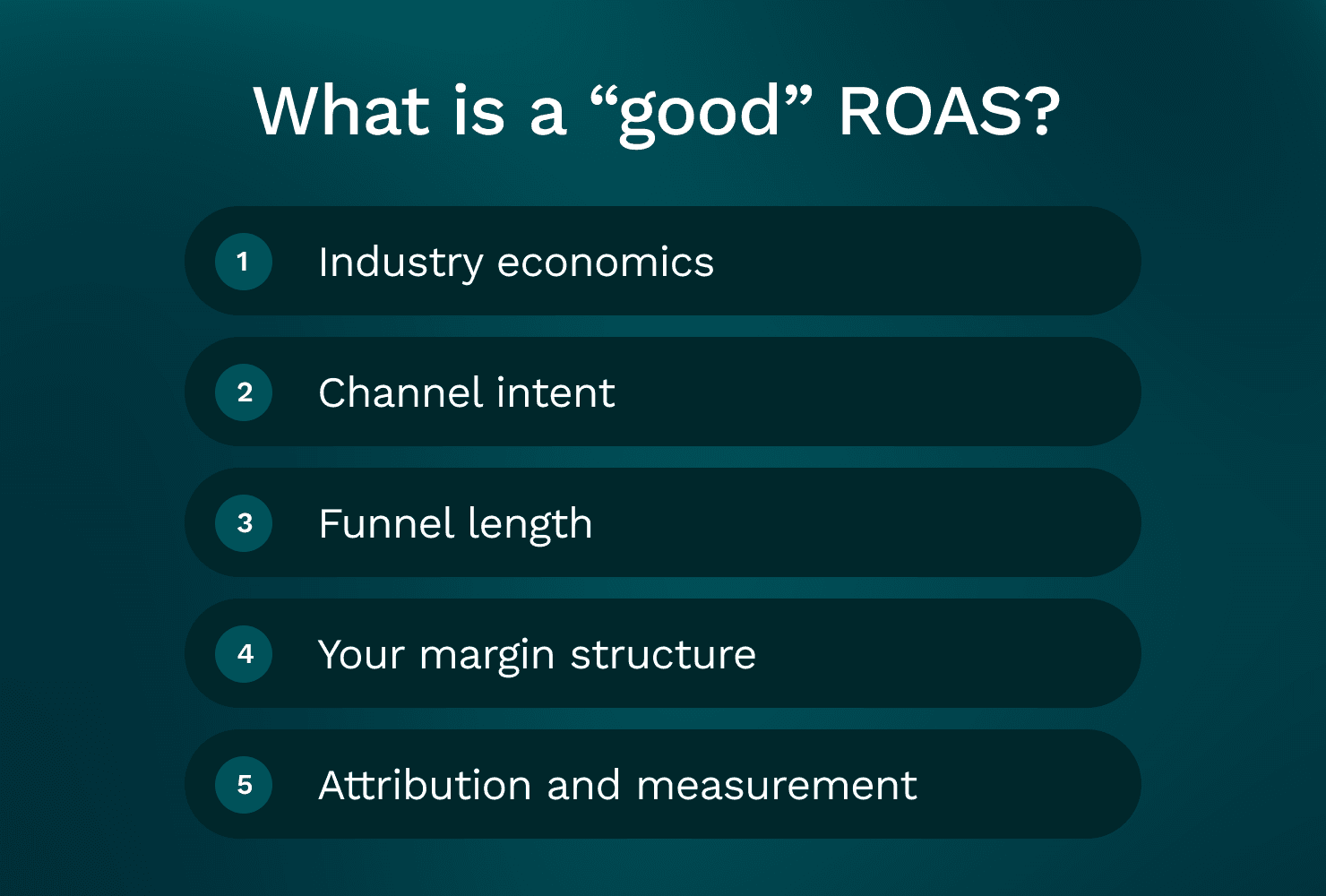
What is a “good” ROAS?
A “good” ROAS is not a universal score. It’s a business-specific target.
Five drivers that change what “good” looks like:
Industry economics (margins, returns, shipping costs, repeat purchase)
Channel intent (Search vs social discovery)
Funnel length (impulse buy vs considered purchase)
Your margin structure (COGS, fulfillment, fees, discounts)
Attribution and measurement (platform-reported vs blended vs modeled)
Common myths worth dropping:
“4x ROAS is always good” (not if your gross margin is 55% and returns are 20%)
“Higher ROAS always means better marketing” (it can mean you’re underspending or only capturing bottom-funnel)
“Meta ROAS should match Google ROAS” (different intent, different attribution behavior)
A practical way to think about it:
‘Good’ ROAS is the ROAS that hits your contribution margin and payback goals.
Quick internal check your team can do:
What ROAS do we need to break even after COGS + shipping + fees + returns + overhead?
If you don’t know that number, industry benchmarks will be interesting, but not actionable.
AI Agent for Paid Teams
Ask question in plain english Get insights across all platforms
Trusted by 1000+ marketing teams across 80+countries
Below is a directional table for blended ROAS across paid social + paid search, assuming typical DTC/ecom tracking (platform reporting plus a blended revenue view in Shopify/GA4).
Assumptions (so you know what you’re looking at):
Mix of Meta + Google (and sometimes TikTok) is common
Windows vary, but most teams are roughly in the 7-day click world (or equivalent modeled reporting)
“Blended ROAS” here means overall paid media efficiency, not one platform screenshot
Use ranges. Not single-point “averages.”
How to read the table
Compare to peers in your category, not to the internet as a whole
Compare trend over time, not a single week
Split prospecting vs retargeting before declaring a win or loss
If possible, segment new vs returning customer ROAS (returning customers can make any account look “healthy”)
Industry benchmark table (blended ROAS ranges for Tier-1 markets, directional)
Important: ROAS benchmarks vary heavily by geography
ROAS benchmarks are not universal. Geography alone can swing “good” ROAS by 2-4×, even within the same industry.
In general:
US / Tier-1 markets (US, UK, CA, AU):
Higher CPMs
More competition
Stricter privacy attribution
→ Lower reported ROAS is normal
India / SEA / LATAM:
Lower CPMs
Cheaper inventory
Faster learning on volume
→ Higher ROAS is common, but doesn’t always mean higher profit
The table below reflects directional ROAS ranges commonly seen in US and similar Tier-1 markets, assuming standard Meta + Google setups.
Industry | Typical margins (directional) | Weak ROAS | Okay ROAS | Strong ROAS | Notes (returns / funnel / etc.) |
|---|---|---|---|---|---|
Fashion / Apparel | 50–70% gross margin, higher returns | 1.2–2.0x | 2.0–3.0x | 3.0–4.5x | Returns and sizing friction often drag net ROAS; promos can inflate revenue ROAS while hurting profit |
Beauty / Skincare | 65–80% | 1.5–2.5x | 2.5–4.0x | 4.0–6.0x | Strong repeat purchase can justify lower first-purchase ROAS if retention is real |
Supplements / Wellness | 60–75% | 1.3–2.2x | 2.2–3.5x | 3.5–5.0x | Compliance + trust matters; subscription mix changes what “good” looks like |
Home & Kitchen | 45–65% | 1.2–2.0x | 2.0–3.2x | 3.2–5.0x | Consideration can be longer; AOV helps but shipping costs can bite |
Consumer Electronics | 10–35% | 2.0–4.0x | 4.0–7.0x | 7.0–12.0x | Low margins force high ROAS targets; warranties/upsells can change the math |
Jewelry / Luxury | 60–80% | 1.0–2.0x | 2.0–3.5x | 3.5–6.0x | Trust, financing, and creative matter; longer decision cycles |
Pet | 50–70% | 1.3–2.3x | 2.3–3.8x | 3.8–6.0x | Subscription and reorder rates can support lower first-purchase ROAS |
Kids / Baby | 50–70% | 1.3–2.2x | 2.2–3.5x | 3.5–5.5x | Safety and trust drive conversion; bundles can lift AOV |
Food & Beverage (CPG) | 30–55% | 1.8–3.0x | 3.0–5.0x | 5.0–8.0x | Shipping + perishability matters; repeat purchase is everything |
Subscription boxes | 40–65% on first box | 1.0–1.8x | 1.8–3.0x | 3.0–5.0x | First order ROAS may look weak but payback can work if churn is controlled |
Local services | Varies widely | 1.5–3.0x | 3.0–6.0x | 6.0–10.0x | Often better measured on CPA and close rate; call tracking changes everything |
B2B lead gen | N/A (pipeline) | 0.8–1.5x | 1.5–3.0x | 3.0–6.0x | Platform ROAS is fragile without CRM; pipeline ROAS is the real benchmark |
SaaS self-serve | 75–90% gross margin | 0.6–1.2x | 1.2–2.5x | 2.5–5.0x | ROAS depends on whether you count first month vs annual vs LTV |
SaaS sales-led / enterprise | 80–95% gross margin | 0.3–0.8x | 0.8–1.5x | 1.5–3.0x | Long funnel; ROAS is often meaningless until you connect CRM revenue |
Footnotes you should not skip:
Attribution model and time window can swing results a lot.
Some accounts look “strong” because they lean heavily on brand search or retargeting.
Affiliate-heavy brands can show unusual patterns due to coupon attribution and last-click bias.
Geography strongly impacts CPMs and ROAS; India/SEA benchmarks often run significantly higher than US ranges shown here.
AI Agent for Paid Teams
Ask question in plain english Get insights across all platforms
Trusted by 1000+ marketing teams across 80+countries
Ecommerce vs SaaS vs B2B
The same ROAS can be “great” or “terrible” depending on the business model.
Ecommerce (DTC)
Payback is usually short.
ROAS is closer to unit economics (still not profit).
A weak ROAS can break cash flow fast.
Example: A low-margin home goods brand at 1.8x ROAS might be unscalable if shipping and returns are high.
SaaS
Revenue accrues over time, so early ROAS often looks bad.
Better paired with payback period and LTV:CAC.
Example: A self-serve SaaS at 1.8x ROAS could be fine if you’re measuring only first month revenue and payback is still under 6–9 months.
B2B lead gen
ROAS depends on lead-to-close, sales cycle, and deal size.
Platform ROAS can be close to meaningless without CRM connection.
Example: A B2B service at 1.2x platform ROAS might still be strong if those leads turn into high-ACV deals later.
AI Agent for Paid Teams
Ask question in plain english Get insights across all platforms
Trusted by 1000+ marketing teams across 80+countries
Affiliate-driven businesses
“Affiliate ROAS benchmark” can mean two different things:
You run ads and the conversion happens through affiliate links or coupon partners
You track affiliate commission as the “cost” and compare to revenue
Either way, affiliate reporting creates weird ROAS artifacts.
Why affiliate ROAS can look unusually high (or low):
Commission-only payouts: costs look low compared to paid media spend
Coupon attribution: affiliates get last click, even if Meta created the demand
Partner overlap with retargeting: you pay twice for the same order (ads + commission)
Last-click bias: makes affiliate look “efficient” and prospecting look “inefficient”
What to benchmark instead (or alongside ROAS):
Incremental lift (holdouts when possible)
New-customer share by partner
Effective CPA after commission
Contribution margin after commission and discounts
Practical separation to avoid double-counting:
Report affiliate as its own channel with clear rules
Compare blended MER and total growth, not just channel ROAS leaderboards
AI Agent for Paid Teams
Ask question in plain english Get insights across all platforms
Trusted by 1000+ marketing teams across 80+countries

ROAS benchmarks by platform (Meta vs Google vs TikTok)
Platform ROAS should not be compared 1:1.
Different intent, different placements, different attribution defaults, different funnel roles.
The common pattern in 2026:
Google Search often reports the highest ROAS (high intent)
Meta tends to be mid-range and scalable (demand creation + capture)
TikTok varies widely and is creative-dependent (often lower early, can improve with iteration)
The clean way to benchmark is:
Benchmark within-platform over time (your Meta vs your Meta)
Then triangulate with blended ROAS and MER
Meta Ads ROAS benchmarks (what’s normal in 2026)
Meta usually sits in the messy middle: part demand capture, part demand creation. ROAS is heavily driven by creative, offer, landing page, and measurement.
Meta ROAS ranges (directional)
Meta campaign type | Typical ROAS range (ecom) |
|---|---|
Prospecting (broad / ASC style acquisition) | 1.2–2.5x |
Retargeting (site + engagers) | 2.5–6.0x |
Lead gen (directional, if you insist on ROAS):
Meta lead gen | Typical “ROAS” range |
|---|---|
Low-ticket / short-cycle services | 2.0–6.0x |
Longer-cycle B2B | 0.5–2.0x |
Why Meta ROAS swings so much:
Attribution window changes and modeled conversions
iOS/privacy effects and signal loss
Creative fatigue and audience saturation
Spend shifts (higher budgets usually reduce efficiency)
Practical interpretation:
If Meta ROAS is down but blended revenue is up, Meta might be under-credited (or your account mix shifted toward prospecting).
Google Ads ROAS benchmarks (Search, Shopping/PMax)
Google is not one thing. Search and Shopping/PMax behave very differently.
Google ROAS ranges (directional, ecommerce)
Google channel | Typical ROAS range |
|---|---|
Search (non-brand + brand mixed) | 3.0–8.0x |
Shopping / PMax | 2.0–6.0x |
Two notes that explain most “my Google ROAS is insane” screenshots:
Brand vs non-brand split matters. Brand search can inflate ROAS massively. Benchmark them separately.
Incrementality matters. Very high ROAS can mean you’re harvesting existing demand. Not always bad, but you should know.
For lead gen, Google is usually better judged on CPA/CPL and qualified lead rate, not ROAS.
TikTok Ads ROAS benchmarks (creative-driven, volatile by design)
TikTok is often upper/mid funnel. It can work as a direct-response channel, but it’s usually creative-first discovery.
TikTok ROAS often starts low and improves if you iterate quickly.
TikTok ROAS ranges (directional, ecommerce)
TikTok campaign type | Typical ROAS range |
|---|---|
Prospecting | 0.8–2.0x |
Retargeting | 1.5–4.0x |
Why TikTok ROAS is hard to judge early:
Learning phase needs volume
Delayed conversions and weaker last-click capture
Attribution gaps and cross-device behavior
Creative fatigue cycles are fast
Practical interpretation:
Judge TikTok with blended lift plus MER, not in-platform ROAS alone.
AI Agent for Paid Teams
Ask question in plain english Get insights across all platforms
Trusted by 1000+ marketing teams across 80+countries
Why ROAS benchmarks differ so much (so you stop comparing blindly)
Here’s what’s usually behind “their ROAS is 6x and ours is 2x”:
Profit margins
Low-margin categories (electronics, some CPG) need higher ROAS just to break even. High-margin categories can scale at lower ROAS.
CAC tolerance and payback window
SaaS can tolerate lower short-term ROAS if payback is healthy. Ecommerce usually cannot.
Attribution differences
Platform vs GA4 vs Shopify can disagree because of:
Click vs view attribution
Modeled conversions
Consent and tracking loss
Deduping across platforms
Creative and offer sensitivity
Some categories are offer-driven (discounts move volume). Others are trust-driven (social proof, reviews, guarantees). That changes what “good” looks like.
Returns, cancellations, fraud
Gross revenue ROAS can hide net reality. Fashion is the obvious case. Subscriptions with churn are another.
ROAS vs ROI
People say ROAS when they mean ROI.
ROAS is revenue-based
ROI is profit-based
Tiny example where ROAS looks good but ROI is negative:
Spend: $10,000
Attributed revenue: $40,000 → 4.0x ROAS
COGS (60%): $24,000
Shipping + fulfillment: $5,000
Returns/refunds: $4,000
Payment fees: $1,200
Profit before overhead = 40,000 - 10,000 - 24,000 - 5,000 - 4,000 - 1,200 = -$4,200
High ROAS, negative profit.
When ROAS is most misleading:
Heavy discounting
High return rates
Subscription businesses with churn
Marketplace fees and promo costs
Practical takeaway:
Treat ROAS as a signal.
Validate it with contribution margin and payback.
How to use ROAS benchmarks correctly
Benchmarks are useful when you use them to ask better questions.
1) Use benchmarks to spot underperformance
If you’re meaningfully below peers, the goal is not “try harder.” It’s diagnosis:
Is tracking broken or undercounting?
Is the offer uncompetitive?
Is the landing page conversion rate low?
Is creative stale?
Is spend concentrated in low-intent placements?
2) Use benchmarks to diagnose scaling limits
As spend rises, ROAS usually drops. That’s normal.
The better question is:
How fast does efficiency decay as you scale?
Benchmark the slope, not just the point estimate.
3) Avoid vanity comparisons
Don’t compare:
Your Meta prospecting ROAS vs someone else’s blended ROAS
Your retargeting ROAS vs their prospecting ROAS
Your 1-day click ROAS vs their 7-day click ROAS
4) Triangulate with supporting metrics
If you’re using ROAS benchmarks, pair them with:
MER (Marketing Efficiency Ratio)
CAC / CPA
CVR (conversion rate)
AOV
New customer %
Payback period
5) Decide on a “source of truth” view
Most strong teams keep two views side-by-side:
Platform ROAS (Meta/Google/TikTok) for optimization
Blended performance (Shopify/GA4) for reality checks
Then they track the deltas over time.
How to improve ROAS
ROAS usually improves when you remove constraints. Not when you find a secret setting.
Creative quality and fatigue
Most accounts in 2026 are creative-constrained.
What to focus on:
Stronger first 2 seconds (hook)
Clearer “why buy now” (offer, proof, urgency)
Better message-market fit (what you say, not just how it looks)
A real iteration cadence (testing pipeline separate from scaling winners)
Offer and positioning
If your category is crowded, ROAS rarely improves from targeting tweaks. It improves from:
Better bundles
Smarter thresholds (free shipping, gifts, tiered offers)
Stronger guarantees and risk reversal
Clearer differentiation on the landing page
Conversion rate and landing page flow
Before you chase a higher ROAS, check basics:
Mobile speed
PDP clarity (price, shipping, returns, reviews)
Fewer distractions at checkout
Post-click continuity (ad promise matches landing page)
Budget allocation (incrementality matters)
Shift spend to the highest incremental return, not the highest reported ROAS.
A classic trap:
Retargeting shows 8x ROAS
Prospecting shows 1.5x ROAS
You cut prospecting to “improve ROAS”
Total revenue plateaus in 3 to 6 weeks
Protect exploration budget even when ROAS pressure is high.
Measurement accuracy
You don’t need perfect attribution, but you do need consistency:
Clean UTMs
Consistent attribution windows in reporting
Dedupe where possible
Post-purchase surveys (helpful for paid social assist)
Regular GA4/Shopify alignment checks
Honest tradeoff:
You can often raise ROAS by reducing scale.
Decide what you’re optimizing for: efficiency, growth, or a balance.
Tools that benchmark ROAS against industry standards
Spreadsheets and dashboards show you numbers. They rarely tell you why the number changed.
A good benchmarking tool should help you:
Normalize time windows and attribution choices (or at least make them visible)
Separate prospecting vs retargeting
Compare across Meta/Google/TikTok while keeping roles in mind
Show distributions (ranges) instead of a single “average”
Flag anomalies (creative fatigue, tracking breaks, mix shifts)
Connect performance to drivers (creative, audience, offer, landing page)
That’s what “benchmarking with context” actually means:
Your margin, AOV, return rate, and attribution model should change what target ROAS makes sense.
Where GoMarble fits
GoMarble helps performance teams understand what’s happening and why across Meta Ads, Google Ads, TikTok Ads, GA4, and Shopify, and compare performance against directional benchmarks without treating them as gospel.
A few non-salesy examples:
“Meta ROAS dropped” → tease apart creative fatigue vs tracking vs spend mix
“Google ROAS is high but MER is flat” → check brand vs non-brand split and demand capture
“TikTok ROAS is low” → check assisted impact and landing page mismatch, not just last-click performance
If you want to explore it: GoMarble ROAS benchmarks by industry.
Benchmark your ROAS with context
If you’re trying to answer “is our ROAS good,” the fastest path is usually:
Compare against directional benchmarks
Then immediately look at the drivers behind the gap (creative, offer, CVR, measurement, channel mix)
GoMarble is built for that workflow: quicker diagnosis, clearer next steps, no promises that a benchmark number magically fixes performance.
Start here: Try Gomarble for Free
If you’re wrestling with discrepancies between platform ROAS and blended results, it can also help to tighten your attribution approach before changing budgets (GoMarble also supports cross-channel analysis across ad platforms plus GA4/Shopify).
What is the average ROAS by industry?
There isn’t a single average ROAS by industry that applies everywhere. ROAS varies widely based on margins, purchase frequency, and sales cycle length. Ecommerce brands often see lower ROAS than B2B SaaS or lead-generation businesses, where one conversion can be worth much more over time. Benchmarks are best used as directional context, not hard targets.
What is considered a “good” ROAS?
Is a 2.5x or 3x ROAS actually good?
How do ROAS benchmarks differ by platform (Meta vs Google vs TikTok)?
Why does ROAS vary so much between industries?
What is a realistic ROAS benchmark in 2026?
Is 800% (8x) ROAS realistic or sustainable?
Why does my ROAS differ from industry benchmarks even with similar spend?
How should I use ROAS benchmarks without misleading myself?
Do ROAS benchmarks apply equally to prospecting and retargeting?
How often do ROAS benchmarks change?
How does ROAS compare to ROI, and which should I trust?
How do I calculate break-even ROAS?
What metrics should I look at alongside ROAS?
What tools benchmark ROAS against industry standards?
From research to results
Go Beyond just analysis - discover winning creatives, research what's working in your market, and make campaign changes directly from your insights